Hope
Mariners' Museum, Uncurated Search Results
Type: Pungy
Year: 1867
Builder:
Location: Lankford Bay

These records are found in the online catalog of The Mariners’ Museum and Park in Newport News, Virginia. Uncurated search results are presented to give researchers and interested readers an idea of whether the museum’s archives contain information about this vessel and whether it may be worthwhile to visit the museum’s catalog search page for further investigation. Uncurated results may be inaccurate or incomplete.
Search mode: Type+Name and Schooner+Name. Search phrase(s): "Pungy Hope"; "Schooner Hope". Results returned: 3. Results displayed in this table: 3.
Use these buttons to send uncurated search results to your own app or text document for further research. First, check the box for any row, or click "Select All" then uncheck any rows. Then click "Show Selections". You can then copy your selections from the text box and past them into your app.
| Fetch? | Row ID | Media | Date | Vessel | Place | Related Places | Inscription/Marks | Subject | Notes | Archive Number |
|---|---|---|---|---|---|---|---|---|---|---|
| 1 | No image URL. | Schooner Hope Leslie | P0001.011/01-#PK0754 | |||||||
| 2 | 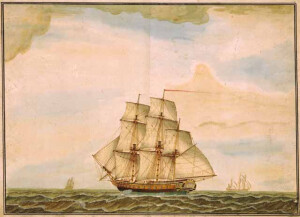 | NOTES: The entry from the auction catalog for the original watercolor sold from the V. Winthrop Newman Collection on February 7, 1921 reads: A clever representation of a frigate in full-sail, carefully detailed and drawn with great precision. In the distance are seen two other vessels; the shortness of the mizzen-mast is remarkable, no provision being made for the to'gallant sail. The artwork was purchased by Pauline Riggs in this sale. Newman, of London and New York, was a member of the British Society for Nautical Research. His collection was sold at an unrestricted public sale at the American Art Galleries in New York on February 7, 1921. It's unclear when Mrs. Riggs aquired the aquatint (LP 2897) that appears to be related to this watercolor. NOTES: HMS Southampton had a very long life built in 1757 and wrecked in 1812. The ship was active during the American Revolutionary War. --The 'Table of the English Navy including the Cruising Stations of Commissioned Ships and the Condition of Non-Commissioned Ships' under date of 21 June 1776 lists Southampton under the category of 'Ships requiring a few months repair.' --On December 25, 1776, the Admiralty ordered Captain William Garnier and HMS Southampton, then at Plymouth, to proceed to Cape Ortegal and cruise north of it, between latitude 45 and 47, for the protection of the trade of His Majesty's Subjects, and "to use your best endeavours to intercept, seize and destroy any cruisers or other vessels belonging to the rebellious colonies of North America which you may be able to come up with." She was to continue on that station until February 6, 1777 and then return to Cork. --February 14, 1777 Southampton and the sloop Cygnet were ordered to escort a convoy to the West Indies. The convoy safely arrived in Jamaica on June 14th, albeit with a sprung mast. Vadm. Clark Gayton reported in July that Southampton was on a cruise with the Winchelsea, Glasgow, Race Horse and Porcupine. On July 4th Southampton fell in with two Spanish 74-gun ships between Heneaga & Cape Nichola full of troops and bound for Havanna. On July 6th Southampton fell in with another 74-gun ship also bound for Havanna. The journal of Capt. William Garnier shows the ship was still stationed at Jamaica in October 3rd. In the journal entry he reported that the boat's tender, named Snail, arrived with a schooner named Tryall from Salem loaded with fish and lumber. --November 17, 1777, Gayton reported Southampton on a cruise with Lowestoffe. Garnier's journal reports on the 11th the Southampton's tender arrived with the ship was sailing off Port Royal with the Washington snow, loaded with rice. --December 7, 1777, Captain Garnier reported that while cruising off Point Isabella on the north side of Hispaniola Southampton chased several small American vessels. When a French frigate arrived and intervened the small American vessels escaped. --On December 19th Garnier's journal indicates the Southamptons boats took the Lark brig with fish & lumber from Newberry for the Cape. Manned the prize and sent it to Jamaica. It was actually the brig Lark from Baltimore, laden with shingles. --On December 21st Garnier's journal notes the capture of the sloop Susannah, Parsons with fish and lumber from Cape Anne. Manned and sent to Jamaica. On December 22nd, Garnier's journal notes the capture of the ship Speculation, Pike master, from Newburyport loaded with lumber. Took the prize in tow and headed for Jamaica. --In a table titled "A List of All Captures which have been condemned in the Vice Admiralty Court of Dominica, since the breaking out of the rebellion in North America' Southampton is listed as having recaptured the snow Prince George. --The Journal of HMS Aeolus, Capt. Christopher Atkins, reported Southampton arrived at Port Royal, Jamaica on December 27 with two prizes. --January 17, 1778 the Snail tender (sloop of war) brought in the prize schooner Unity, Hilton, from Salem with fish and lumber. --The table “A List of Rebel Vessels, Taken by the Squadron, of His Majesty’s Ships & Vessels, Under my Command at Jamaica, between the 21st day of December 1775 and the 26th day of February, 1778” published in volume 11 of ‘Naval Documents of the American Revolution’ lists all of the prizes taken by Southampton or one of its tenders. Other prizes from volumes 12 and 13 are also included in this list: 1) sloop Swift, loaded with sugar; 2) schooner Sally from Boston loaded with fish and lumber; 3) unnamed schooner from Carolina loaded with staves and tobacco; 4) schooner Hope loaded with tobacco, staves &c.; 5) schooner Georgia Packet, loaded with rice and indigo; 6) schooner Tryall from Salem loaded with fish & lumber; 7) schooner Sally from Georgia loaded with rice and coffee (captured before October 18, 1777); 8) snow Washington loaded with rice ( Captured before November 11, 1777); 9) schooner Hazard, John Smith, from Virginia loaded with tobacco and flour (Captured on 7 Dec. 1777, from Virginia to Cape François); 10) sloop Speedwell, Thrift, from South Carolina loaded with lumber and rice; 11) brig Lark, from Baltimore loaded with shingles &c (Captured on 19 Dec. 1777, from Newburyport to Cape François); 12) ship Speculation, Pike, from Newport with Lumber (Captured on 22 Dec. 1777, from Newburyport to Saint-Domingue); 13) schooner Unity, Hilton, from Salem loaded with fish & lumber (Captured on January 17, 1778); 14) brig Henry, Dailey, from North Carolina loaded with lumber &c.; 15) Southampton’s tender Vixen participated in the capture of the schooner Angelina from South Carolina to Cape Francois with a cargo of tobacco, rice and indigo; 16) one of the tender’s of Southampton participated in the capture of the sloop Swallow in Isabella Bay, Kahue master, 20 tons burthen with a cargo of tobacco; 17) schooner Barter, Jno. Parsons, 70 tons, from Newburyport to Cape Francois with a cargo of fish and lumber, taken at Heneaga on March 28, 1778; 18) participated with Niger in capture of sloop John’s Milsey, loaded with tobacco staves and corn; --On March 7, 1778 Southampton was in Pensacola working on the defense of West Florida (Louisiana) against American rebels. -- June 25,1778 Southampton helped escort a convoy of 104 ships from Blue Fields Bay, Jamaica. War of 1812 The United States brig Vixen was captured by HMS Southampton on November 22, 1812 during the War of 1812. Five days later both vessels were wrecked on a reef in the Bahamas, marooning everyone on Conception Island for about ten days. After rescue and transport to Port Royal, Jamaica Vixen’s crew were imprisoned on the Loyalist prison ship. See the attached publication: 'A Narrative of the Capture of the United States Brig Vixen, of 14 guns, by the British frigate Southampton; and the Subsequent loss of both vessels, on a reef of rocks, off Conception Island...' by one of the Vixen's crew, for a detailed account of the capture and shipwreck. | CL6612 | |||||||
| 3 | SHORT DESCRIPTION: Builder’s half hull model, starboard side, made by Henry Steers of the schooner yacht Hope. The model is a basic representation of the vessel's molded lines, without constructional details. The model is not mounted on a backing board. It is varnished and inscribed in black-outlined letters “HOPE”. The stem has minimal rake and has a raked hour-glass shaped upper stern (no counter). It has moderate deadrise and little or no tumblehome. The model depicts a boat with deep draft aft and a keel that slopes up to the forefoot. It has a concave bow and a long sharp entry and a long run aft. The model is constructed of 9 lifts and two wedges, probably pine. The bottom lift is approximately 1-3/8” at the stern and tapers to zero about 28-1/2” from the stern. Lifts 2 through 8 are flat and 1/2” thick. Between lifts 8 and 9 there are two wedges, one at the bow and one at the stern. The wedge at the stern is 1-1/2” and tapers to zero 15-1/2” from the stern. The wedge at the bow is 1-15/16” and tapers to zero 17” from the bow. Lift 9 is the top covering of the model. It curves with the sheer formed by the two wedges. It is 27/32” high at the bow, 13/16” amidships, and ¼” at the stern. The dimensions of the model are 44-3/8” (length overall); 5-3/16” (main breadth), 5” (half breadth), leaving a tumblehome of just 3/16”. Height overall is 6-3/4” (at the stern). The minimum half-breadth of the model is 1/8" along the edge of the stem and stern. On the back of the model there are twenty-one penciled station lines running perpendicular to the lifts. The first station line is about 1" from the sternpost or 3-3/4" from the extreme end of the stern and the others are at roughly 13/16" intervals. There are twenty station lines penciled on the top of the model, the lines get very faint towards the bow so there may be more than twenty. They range in size from 13/16” to 1-7/8” apart. The lifts are held together with three wooden pegs and several screws. There are a few variously sized holes whose purpose is not apparent on the top and back of the model. The model is in fair to good condition. Lifts 2 through 5 are missing pieces at the stern: lift 2 is missing 1-3/4”, lift 3 and 4 are missing 1-7/8”, and lift 5 is missing 1”. The varnish is in good condition with no craquelure. There are minor scratches and dents scattered overall. There are thick scratches over the “P” in the yacht’s name. NOTES: The collection of half models MR 5 through MR 24 are of vessels built by shipbuilders Henry (father), James Rich and George (sons), and Henry Steers (son of James Rich), builders of the famous yacht America. The models document vessels built between 1805 and approximately 1876. They encompass all types of vessels from a catboat up to large steam sloop built for the US Navy. In a February 13, 1963 letter Howard I. Chapelle, Curator of the Division of Transportation at the Smithsonian stated “The Steers Collection is important technically and it is something we envy the Mariners’ Museum’s possession.” NOTES: Text from: Harper’s Weekly, May 11, 1878, page 369 for image (attached) and page 370 for description of new rig: OUR engraving of this handsome craft, shows the new rig adopted some time since for the New York pilot-boats. They are now rigged as nearly as possible like the beautiful and swift-sailing pleasure-yachts that enliven American waters during the summer season, with the modifications needful to fit them for the rough and tempestuous weather they may be compelled to encounter on the cruise for incoming vessels. Text from: Pilots, The World of Pilotage Under Sail and Oar, Vol. 1, Pilot Schooners of North America and Great Britain, pages 82-83. Shows lines drawn by Howard I. Chapelle and provides the following description of the image in Harper’s Weekly: The Hope was a powerful schooner driven hard by an enthusiastic crew. Behind her main boom is the fort on Governor’s Island and over her bowsprit is the Brooklyn Bridge under construction. She is seen here sporting a highly inventive addition to a schooner’s wardrobe, a square topsail on the mainmast. The sheet is led to the boom end like a fisherman staysail but, when arranged conventionally, these sails did not use a year. The lead of the tack is not visible, so perhaps this is some type of hybrid. VESSEL NAME: HOPE, HOPE No. 1 VESSEL TYPE: Schooner, Pilot schooner DESIGNER: Henry Steers BUILDER: Henry Steers BUILDER LOCATION: Greenpoint, Long Island, New York BUILD DATE: 1861 SHIPOWNER: Thomas Boynton Ives (1861); US Government (1861-1865?); New York pilots (1865-1891) SERVICE DATES: 1861 (US Revenue Yacht); 1861-1865 (US Dispatch boat); (1866-1891) pilot boat FATE: Wrecked on Sandy Hook Point March 13, 1891. DIMENSIONS: American Yacht List of 1874: 90’0” (overall length), 84’0” (waterline length), 21’6” (beam), 9’6” (depth), 10’ (draft); 132.40 tons (old), 59.62 tons (new) VESSEL HISTORY: • New York Daily Herald, March 11, 1861: New York Daily Herald (New York), March 11, 1861: At Greenpoint, Mr. Thomas Boynton Ives of Providence, is having built, by Henry Steers, a schooner yacht of one hundred and thirty tons measurement, which will take her rank among the first class boats of the squadron. She will be ready for her element on Tuesday next, when, Providence permitting, the launch will take place about ten o'clock in the morning. She has been christened "Hope," an emblem of the feeling predominant in every yachtsman's breast from the time his pet leaves the stocks until she has been beaten beyond all redemption. Her dimensions are as follows: Length on deck, 91 feet; beam, 21 feet 6 inches; depth, 8 feet 3 inches; length of masts, 74 and 76 feet; topmasts, 29 feet; bowsprit (outboard), 14 feet 6 inches; jib boom (outboard), 15 feet; main boom, 53 feet; fore do., 38 feet. Below, her fittings as regards both comfort and elegance are of the most substantial character. Forward are six berths for her crew with lockers and closets for the disposition of their wardrobes, and a dining table abaft the foremast. This apartment is separated from the kitchen by a bulkhead. The culinary department is of the most commodious character, embracing besides a range a four hundred gallon water tank, a refrigerator and provision locker, a thousand convenient little drawers, corners and crevices, which no one can use or appreciate as well as the cook, or, in maritime parlance, "the doctor." In the rear of the kitchen, and on either side of the passageway leading thence to the cabin, are staterooms and the pantry. Two of the former are fitted up as tastily as a ladies' parlor, are as large as many of our crack hotel attic bed chambers, and embrace all the comforts of a double bed, stationary washstand, drawers, closet, mirror, &c.--no mean belongings to any craft, the reader will echo who has lived on shipboard a month or six weeks. In the floor of one of these is the opening of a tank which holds six hundred gallons of water. On the opposite side of the passageway is the captain's stateroom; another of similar dimensions for extra company, and a pantry. The last includes an ice box and arrangements for dishes, silver and all the paraphernalia of what will readily be understood by the term of "a good time." The cabin is a large apartment, six feet two inches high, furnished in white and gold, and contains four berths, with supernumerary arrangements for improvising as many more. The decorations and upholstery are not yet complete; but they are far enough advanced to convey the most suggestive ideas of comfort and content. • New York Daily Herald (New York), March 14, 1861: Launch of the Yacht Hope. This new and beautiful schooner, of which we have heretofore given a full description, was launched at yesterday noon from the yard of Henry Steers at Greenpoint, L.I. A large "cloud of witnesses" were attracted to the scene, and the presence of a considerable number of ladies, the fluttering of the club signal from the masthead of the new yacht, and the display of bunting from the surrounding craft, invested the occasion with an aspect decidedly festive. The preparations for the launch were completed as early as eleven o'clock. The jib boom had been "housed" to prevent its contact with mother earth as the parting bow was made, riggers had done their work and departed, the few necessary stores, including two beautiful mahogany mounted brass guns, were sent on board, blocks were knocked away, the gangway plank removed, and the tiny vessel rested in her cradle, waiting only the command of the master to glide down the slippery ways into her future element. "Are you ready?" says a clear voice "Aye, aye, sir," is the response. Then "Go ahead!" and in an instant a dozen sledge hammers are driving the wedges to fasten her firmly in her place. This done, the supports beneath the keel are one by one removed, until nothing but her own weight holds the yacht in curb. Mr. Steers moves around to discover the cause of detention. Nothing is apparent, however, and he gives her the aid of a little impetus. A jackscrew is applied under the boat. Still she moves not. "Get out your battering rams," says the builder. A couple of these are accordingly improvised for the occasion from some of the surrounding timbers, and with tremendous force a dozen or twenty strong men drive them against the ends of the ways. They start an inch or two, and so do the crowd towards the end of the dock to see her touch the waters. But still the vessel sticks. A little more effort, and another inch is slowly gained, and another, and another, until, in half an hour, a whole foot has been moved over. The prospects begin to darken. The company on board peer anxiously over the side to see, if possible, what is the trouble. The master too is evidently disconcerted at the idea of a failure. A tugboat is near at hand, and some one proposes to pass a line to her from the yacht, and thus bring a new power to bear. This is accordingly done, and after a few efforts, aided by running up and down the decks of those on board, the yacht is finally started, and amid the cheers of the crowd and the smoke of her own salute, glides gracefully into the water. The new fledgling is a beautiful specimen of art in every sense of the word, and the builder and owner both received the encomiums of a large number of gentlemen connected with the New York Yacht Club. Among others present were the Vice Commodore, Moses H. Grinnell, C. T. Cromwell, and Captain Comstock, late of the Adriatic. • From The United States Revenue Cutters in the Civil War by Florence Kern, pages 8-3 to 8-9: Shortly after the start of the Civil War several yachtsmen in New York offered their services to the Union. Two yachts were accepted (as U.S. Revenue Yachts), James Gordon Bennett Jrs. new 158-ton schooner Henrietta and Thomas Boynton Ives schooner Hope. Both men were commissioned Lieutenant Commanders and given two NCO’s, ten men and $353 a month. Their duties would entail “the fitting out of slavers and other illicit trade” and intercepting vessels carrying “arms and munitions of war unless she is in the service of the United States.” The yachts were armed and dispatched in July 1861. Ives’ Hope was sent to Baltimore where he discovered the port being handled poorly and that “nothing whatever had been done to prevent vessels from leaving the port at any and all times and that after they left the dock no measures were taken to ascertain of what their cargo consisted.” He immediately began organizing a method for clearing and searching vessels. By the first of August they had boarded 150 sailing vessels. Ives was periodically ordered by General John Dix to examine particular steamships and seize any contraband: three trunks of military buttons and buckles were seized from the Mary Washington and eighty colt navy pistols, about 40,000 percussion caps and a third of a barrel of quinine in bottles were seized from the steamer George Weems. Within two weeks Ives had boarded about 39 vessels a day. Hope remained in the Chesapeake until October 11 when she was ordered to New York. On November 4th he asked to withdraw his yacht from the service and four days later she was decommissioned. • Philadelphia Inquirer, November 30, 1861: Despatch Boats for the South.—The yacht Hope, a fine schooner of one hundred and forty tons, was purchased in New York, on Thursday, for the Government. The yacht is present at Providence, R.I., and has been coasting in the revenue service during the past summer. She carries two guns, and can accommodate a crew of twenty-five men. The Hope will be sent to the Navy yard in a few days to receive her crew and stores. She will probably proceed to Port Royal, carrying mails and despatches. o September 12, 1862, Hope, acting master Breeze, was off Charleston. o February 10, 1863: The British schooner Emma Tuttle, from Nassau, with a cargo of salt, saltpetre and earthenware for the rebels, was also captured off Charleston on the 27th ult., by the Navy dispatch yacht Hope. A prize crew was put aboard her from the Keystone State. • Brooklyn Daily Eagle, January 23, 1866: The new pilot boat Hope No. 1, went on her trial trip yesterday down the Bay, steaming from the foot of Bridge Street, about 11 o’clock, with a number of Brooklyn citizens on board. The Hope was originally intended for a pleasure yacht, and was owned by Governor Sprague, of Rhode Island; but was, at the outbreak of the war, sold by him to the government, in which employ she has since been used for revenue and coasting purposes. She was purchased by the pilots for six thousand dollars, but has undergone extensive alterations, in fact has been almost entirely rebuilt, and is now better adapted for her new service. She is now valued at twenty thousand dollars. The following are her dimensions: length, 90 feet; breadth of beam, 21 feet; depth of hold, 9 feet 6 inches and 60 tons burden, new measurement. She is under the command of Captain Thomas Morley, one of the most experienced New York pilots, who is joint owner with Messrs. Carey, Lyons, Roach, Samson and Rush, pilots. The Hope rand down to Sandy Hook, and a few miles outside, proving an excellent sailer, and on the return her speed was tested by a race with the E. F. Williams, counted the fastest boat in the pilot service. The Hope beat the Williams easy, establishing her reputation as a crack boat of the fleet. The trip gave the guests some idea of the hardships of a pilot’s life, and at the same time a specimen of the hearty hospitality of the sailor. Some excitement was created by the hoisting of a green flag, with the sunburst—the Fenian banner, and gave rise to a rumor, gravely reproduced with big headlines in a morning paper, that Fenian privateer had sailed from New York. • The Buffalo Commercial, January 29, 1866 reported: The News a few days ago gave prominence to a statement that a Fenian privateer had slipped out of port and was prepared to do a large “gobbling up” business &c. It appears that a very fast sailing pilot boat, the Hope No. 1, left port for a short trip outside the Hook [this was actually the boat’s sea trials as a pilot boat], and the festive captain, who is an Irishman, ran up the Green Flag as he took his departure, not thinking any one would impute privateering intentions to him on that account. The festive party returned the next day, and were greatly amused at the sensation they had created. The Standard of London indicated that the trip was the vessel’s “trial trip”. • The Evening Star (Washington, D.C.), December 19, 1866 indicated that “the pilots of Boat Hope No. 1 have accepted the challenge of D. Jones (another pilot boat?), for a race from New York to Cowes for fifty thousand dollars.” On January 15, 1867 the Commissioners of Pilots expressly forbid any New York pilot boat, particularly the S.D. Jones and Hope from entering into such a contest and the matter was dropped. • The New York Times, March 13, 1867 reports: Disaster on Pilot Boat #1.—On Sunday, March 10, on board the pilot-boat Hope No. 1, of New York at 3am off Fire Island, Robert Murray, a native of Aberdeen, Scotland, while furling the foresail, fell overboard, and was drowned. The yawls were manned, but the morning was so dark they could not find him. • The New York Times, March 23, 1867 reports: Capt. Thomas Morley, of the pilot boat Hope, No. 1, reports this morning at 6 o’clock, saw steamship Australasian, with signal for pilot flying; blowing a severe gale from east northeast. In attempting to reach her stove the starboard yawl and washed overboard Edward Franklin, a native of France, one of the hands. Every exertion was made to save him but without effort. Soon after split the foresail and bore away for the Hook. • The Bangor Daily Whig and Courier, April 12, 1867 reported that on Wednesday in lat. 40 long 71, saw a schooner flying with colors flying union down. She proved to be the schooner Wm. H. Sergeant of Sedgwick, 35 days from Darien, Georgia board for Norwalk. The captain stated that they had had nothing to eat for four days. She was supplied with provisions by the Hope. • The New York Daily Herald, May 30 1869 reported: The pilot boat Hope was lowered yesterday noon from the central one of the screw docks, near the foot of Market slip, after having her copper sheathing patched and her top side painted. The New York Daily Herald of May 24, 1870 reported that Hope No. 1 was again put in the dock to have her copper patched. • New York Daily Herald, May 6, 1872 reports the Hope was again in the dock to have her metal cleaned and patched. • New York Daily Herald, May 12, 1872 reports: On Friday last, at 9am, 20 miles east by south of Sandy Hook, Frederick Floyd, seaman, aged 23 years of Sweden, was knocked overboard by the jib sheet of the pilot boat Hope No. 1 and drowned. • Brooklyn Daily Eagle, September 24, 1873 reports: Messrs. Poillon are also rebuilding from her original lines the fast pilot boat Hope. • The Brooklyn Daily Eagle, October 8, 1873 lists Hope, Pilot boat #1, 182.64 tons, owned by the New York Pilots. Participating in the Ocean Race for the Bennet Cup on October 9. • New York Daily Herald, March 21, 1874: Thomas Morley is Sandy Hook pilot of boat Hope No. 1. • New York Daily Herald, February 4, 1876 reports: Lost in a Hurricane, Horse Shoe, N.J. February 3, 1876. Thomas Morley, of pilot boat Hope No. 1, reports that on February 2, at half-past five o’clock am ten miles southeast of Sandy Hook lightship, he put William Roache, pilot, on board steamer Egypt; and when the yawl was returning to the pilot boat and within hailing distance, she was struck by a hurricane from west-northwest. All sail was taken in, and no more was seen of the yawl, with Charles Smith and Henry McPherson in her. Fears are entertained that she capsized and the men were drowned, as he could not see anything of them afterward. • Alexandria Gazette, December 3, 1877 reported: The schooner Nellie H. Benedict and schooner Horace Moodie collided off Barnegat and both vessel sank. The crews were saved by the Pilot boat Hope No. 1. In June of 1878 the Pilot Commissioners voted the crew $100 for their efforts. • The Sun (New York), February 21, 1878 reported that the schooner Lucretia, in sinking condition, asked the men of pilot boat Hope No. 1 for assistance in reaching port safely but was told only if he paid $1500. If he didn’t they would cast him off and he would be driven ashore or be carried northeast on the Gulf stream. The captain tried to negotiate better terms but was unable and accepted the terms when the crew of the pilot schooner prepared to cast them off. • The Times (Philadelphia) March 28, 1880: The pilot boat Hope No. 1 escorted the USS Constellation from Brooklyn Navy Yard out past Sandy Hook. The ship was leaving for Dublin with relief supplies on board for the “suffering Irish poor.” • New York Tribune reported December 3, 1880 a collision between the pilot boat Hope No. 1, which was anchored off Stapleton and the schooner John Long. The pilot boat was slightly damaged, the schooner escaped with the loss of her headsail. • The New York Times, February 3, 1885 reported that Thomas Morley of Pilot boat Hope No. 1 was in charge of the ship Werra of the North German Lloyd. When the ship passed Sandy Hook the weather was blowing so furiously he was unable to leave the ship. The ship proceeded to sea with the pilot on board. Pilots caught in this situation were entitled to $100 sea pay per month from the company whose vessel took him from his station. • New York Times, February 23, 1885 reported the pilot boat Hope No. 1 missing, which was looked for about the middle of last week but has not returned to port. She was reported some distance from Sandy Hook before the heavy storms of the week before. The next day pilot Carroll of the Hope No. 1 arrived on an incoming brig and reported the vessel was all right when he left her. • New York Tribune, February 16, 1886 reported the pilot boat Hope was beating down the Bay yesterday noon, and abreast of Quarantine Island fouled the schooner Raymond T. Maull, which was at anchor. The Hope lost her mainmast and fore-topmast, and the schooner her jibboom. • New York Times, August 15, 1886 reported a near mutiny on board the pilot boat Hope No. 1. When the crew were asked to make sail they refused saying they didn’t want to go to sea until the next day. Captain Thomas Morley and the pilots could not persuade the men to do their duty. The Captain of the Sylvan Stream learned of the situation and reported it to the Barge Office which sent word to the police boat Patrol which steamed down the bay and arrested the mutinous sailors. This was the first case on record of a near mutiny occurring on a pilot boat. • New York Times, July 31, 1887 reported that Captain Thomas Morley, one of the oldest Sandy Hook pilots died suddenly. He had served as a pilot on the Moses H. Grinnell and had been on board pilot boat Hope No. 1 for twenty years (he was part owner). • New York Times, August 25, 1887 reported that a wave washed over the boat during an easterly gale and washed the boatkeeper, Charles Waldon, and two unnamed crew overboard. The boat’s foremast was sprung during the storm so the boat was towed to Poillon’s yard to be fitted with a new spar. • The Atlanta Constitution, March 13, 1888 reported The pilot boat Hope, dragged her anchors while off Tompkinsville last night during a blinding snowstorm and went ashore on the rocks off Fort Wadsworth. Her crew is standing by her. • The St. Albans Daily Messenger, April 19, 1890 reported that on April 10 the pilot boat Hope No. 1, was run down tonight by an outgoing steamer while off Owl’s Head, Long Island, and cut to the waters edge. There was a high sea. The steamer refused to render assistance. The Hope’s crew of six abandoned the vessel and she now lies on the beach below quarantine station. The New York Times reported the following day that the ship was refloated and towed to the city for repairs. • The Evening World (New York), March 13, 1891 reported: Wrecked on Sandy Point. The fog which settled down last night grew denser at midnight. At 1:20 o’clock this morning the pilot boat Hope No. 1, went ashore on Sandy Hook Point, in the exact spot where the Scotia was wrecked last year. She struck about fifty feet out from the beach, and in ten minutes her condition was seen to be hopeless. The crew of the Hope were all rescued with great difficulty by Capt. Patterson and his Life-saving crew No. 1. The surf ran very high and the life-savers’ lifeboat was capsized and stove in. The men all got ashore in safety, however. The Hope was pounding very heavily on the rocky beach. At daylight it was seen that the rudder was gone, her keel torn off, and great holes in her hull. She is a total wreck. Her yawl had been washed away. ADDITIONAL INFORMATION: SEE: Yachts and Yachting with over One Hundred and Ten Illustrations, by Fred S. Cozzens and Others, 1887, references on page 65. | CL14542 |
Created 2026 by Don Barker, CBMM volunteer, for the Chesapeake Shipbuilding Project. shipbuilding@sailingworkboats.es